Strategy ·
App or Website — Which Does Your Saudi Business Need First?
Short answer: for most businesses, the website comes first. It puts you in Google results, works on every device with no download, and costs a fraction of an app. An app earns its budget when the same customer comes back weekly — not when you want to look modern. And here is the detail almost nobody mentions: you cannot publish an app on Google Play at all without a privacy policy hosted on a website. So the real question was never "which one" — it is "which one first". Here are seven questions that settle it, from a team sitting inside Play Console right now.

We get this request most weeks: "I want an app for my business." When we ask why, the answer is almost always one of three — a competitor launched one, someone said an app looks more professional, or the owner used a big retailer's app and liked it. None of those is a technical reason, and none of them is about your customers. We build both websites and apps, so we have nothing to gain by pushing you either way. Here is the honest answer, the same one we give clients before they sign anything.
The rule that settles most cases
The real difference is not technical, it is behavioural. A website serves people who are searching for you and do not know you yet. An app serves people who already know you and keep coming back. That is why apps work for restaurants, delivery companies, and banks — their customers open them several times a week. A contracting company, a clinic, a law firm, or a wedding photographer deals with the same customer once or twice a year. That customer will not download an app, and if they do, they will delete it a week after the job ends.
So ask one question before anything else: how many times a month will my customer open this app? If the answer is fewer than four, you are building something destined for the last page of their phone until it gets deleted. The same money spent on a fast website that ranks in search brings you customers who do not know you yet — and that is where growth actually comes from.
The part nobody writes about: an app needs a website anyway
This single point ends the debate in practice, and we could not find it covered in any Arabic article on the topic. To publish an app on Google Play, Google requires a link to a privacy policy hosted on a publicly accessible web page — reachable without logging in. Apple asks for the same. Which means you need a website, even a single page, before you can press publish at all.
On top of that, your app store listing does not surface in Google results the way a website does, and a customer who hears your company name types it into Google, not into an app store. If nothing comes up, the story ends before it starts. An app is a tool for keeping customers. A website is the tool for getting them. The order is not a matter of taste.
How long does publishing an app actually take? A number from inside Play Console
Most business owners assume an app goes live the day it is finished. The reality is different: new personal developer accounts on Google Play must run a closed test with at least 12 testers, for 14 continuous days, before they are even allowed to apply for production access. One day where a tester drops out can send the counter back to the start.
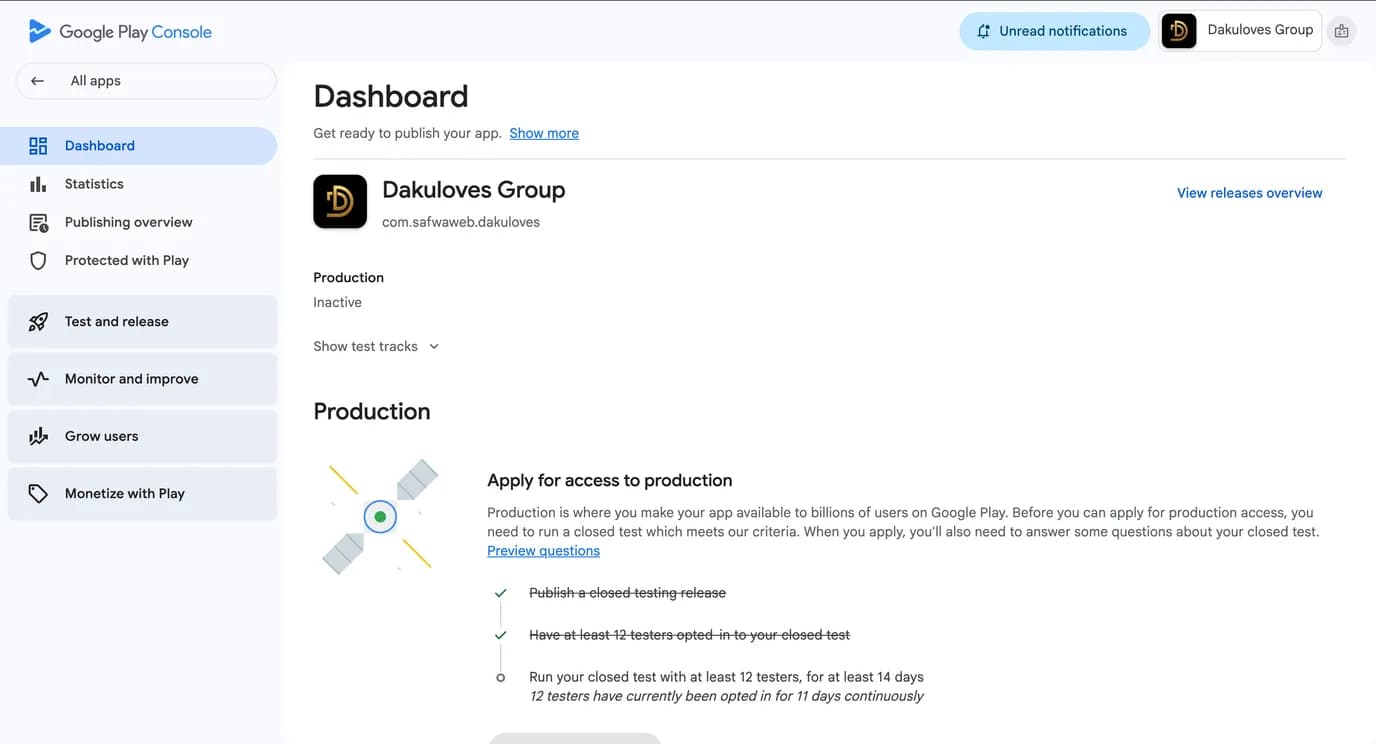
That is a real screenshot from our account, not an illustration. We show it because it captures what we tell every client: a website can be in front of your customers within days, while an app has a time gate nobody can skip — not us, not anyone. Any agency promising a published app "within a week" either does not know this rule or knows it and is not telling you.
Seven questions that settle your decision
Answer these honestly and the decision makes itself. Each one ends in a straight verdict:
1. How often does your customer deal with you in a month?
A restaurant, a pharmacy, or a monthly subscription: high frequency. A contractor, a lawyer, an interior designer, a wedding photographer: almost none. Verdict: fewer than four times a month means website first, no debate.
2. How does a new customer look for you today?
If they are typing "contracting company in Riyadh" or "wedding photography Jeddah" into Google, you need something that appears in those results. Apps do not. Verdict: if search is where your new customers come from, a website is not an option — it is the entry ticket.
3. Do you need push notifications — or is WhatsApp enough?
Push notifications genuinely are the strongest thing apps offer. But in the Saudi market specifically, WhatsApp does that job at near-zero cost, and its messages get read more reliably than most app notifications. Verdict: if your goal is reminding a customer about an appointment or an offer, start with WhatsApp and keep the app budget.
4. Do you need the device itself?
Camera access, continuous GPS, working offline, Bluetooth, live driver tracking on a map — a browser does not do these to the same standard. Verdict: if your service genuinely depends on one of them, an app is the right tool, not a luxury.
5. How does your customer pay you?
Saudi payment gateways — Mada, Apple Pay, STC Pay, Tamara, Tabby — will usually want a working website or licensed store showing your terms, refund policy, and contact details before approving your account. And publishing through an app store means the store takes a 15% to 30% cut of your digital sales. Verdict: a website pays you in full, with no intermediary taking a percentage.
6. What is your budget after launch, not before it?
An app is not a one-time expense. There are annual developer account fees, forced updates every time Android or iOS changes its requirements, store review on every release, and maintenance across two platforms if you want Android and iOS. Verdict: if year two is not budgeted, the app dies after twelve months. Check what a website costs in Saudi Arabia to see the difference in real numbers before deciding.
7. Have you actually validated the demand?
The riskiest case we see: an idea never tested on a single customer, and an entire budget going into an app. A website lets you test the idea in weeks at a fraction of the cost — and once demand is proven, you move to mobile app development knowing exactly what to build and for whom. Verdict: never build an app for an idea nobody has paid for yet.
The quick comparison
| The job | A website | A mobile app |
|---|---|---|
| Being found by people searching Google | Excellent — that is what it exists for | Weak — apps do not appear in search results |
| Access with no friction | One link, works on any device instantly | Requires a download, permission, and storage |
| Serving a customer who returns weekly | Good | Excellent — notifications and saved preferences |
| Cost to launch | Far lower | Higher, and two platforms mean two builds |
| Speed to reach customers | Days to weeks | Weeks, plus store testing and review |
| Updating and editing | Immediate | Goes through store review on every release |
| Commission on sales | No intermediary, no cut | Store takes 15% to 30% of digital sales |
| Privacy policy requirement | It is where you publish it | Requires a link to an external website |
A third option nobody mentions: the progressive web app
If you are still undecided after all of the above, there is a middle path that Arabic articles on this subject never cover: the progressive web app (PWA). In short, it is a website built to behave like an app — the user adds it to their home screen with its own icon, it opens full-screen with no browser bar, it works partially offline, and it can send push notifications on Android.
What makes it interesting is that it skips every gate described above: no closed testing, no store review, no commission on sales, and no two separate builds for Android and iOS — while remaining a website that appears in Google search results. You get much of the feel of an app without giving up the website's core advantage.
It has real limits: notifications on Apple devices are weaker and more restricted, access to advanced device features falls short of a native app, and you will not appear in the app store if being there matters to your customers. But in many of the cases where someone asks us for "an app", this is genuinely the right answer — at a fraction of the cost and time. Ask about it before signing a full app contract.
Five signs the person selling you an app is not thinking about your business
Before signing any app contract, watch for these. Each one means the person opposite you is selling what they want to build rather than what your business needs:
- They never asked how often your customer deals with your business in a month. That is the first question in this profession, and skipping it means they are building for their invoice, not your customers.
- They promised a published app "within a week". You saw the closed testing requirement above — anyone promising that either does not know the rule or is hiding it from you.
- They quoted Android and iOS as one number without explaining that these are two separate tracks in development, testing, and maintenance.
- They never mentioned year two at all: no developer account fees, no forced updates when operating systems change requirements, no store review on every release.
- They never asked about your existing website or your privacy policy — a requirement without which no app gets published at all, which means they have not actually taken a real client through publication yet.
Two or more of these and you should get a second quote. We say this despite selling both services, because a client who buys an app they did not need never comes back.
When an app genuinely is the right call
We are not against apps — we build them. But an app earns its budget in specific, recognisable situations:
- A service the same customer uses weekly or more: delivery, repeat bookings, subscriptions, loyalty and points.
- Operations that depend on the device: tracking field staff on a map, barcode scanning, capture-and-upload, offline field work.
- An existing, known customer base — you have people to invite on launch day, not an audience you hope to find.
- An internal team needing a field operations tool, where the app is an efficiency instrument rather than a marketing channel.
- A business model built on repeat purchase, where the app lowers cost per order over time.
If two or more of those describe you, an app is an investment rather than an appearance — and we are happy to scope it honestly.
What building an app actually involves — the stages quotes leave out
When someone says "we will build you an app", what you are buying is not a set of nice screens — it is a chain of stages, each one costing you time and decisions. Here is how it actually runs:
Definition before development
Who exactly is the user? What single task will they open the app to do? What happens when they have no internet? These get settled before a line of code is written, because changing them mid-build means redoing work rather than adjusting it. Projects that stall — ours and everyone else's — stall here, not in the programming.
Version one: one feature done well, not ten done adequately
The most common mistake is trying to launch everything you imagined at once. A successful first version does one thing properly — bookings, say, or order tracking — and leaves the rest to later releases built on real usage rather than guesswork. Every extra feature in version one means longer before you find out whether anyone will use the app at all.
Designing for two platforms, and in Arabic
Android and iOS have different interface conventions, and users on each expect behaviour that feels native to their device. On top of that, an Arabic right-to-left interface is not simply a mirrored layout: fonts, directional icons, numerals, and navigation order all need separate review. That is real effort, and it is routinely left out of quotes.
Testing and publishing
This is where the time gate we showed above applies: a closed test with enough testers for a continuous period, then the production request, then store review — which can send the app back with notes. And every later release goes through review again, unlike a website where you publish an edit in minutes.
After launch — the part that surprises everyone
A published app needs ongoing attention: Android and iOS raise their technical requirements periodically, and an app left un-updated can end up hidden from the store. Add crash monitoring, security updates, and support for new devices every year. A website needs maintenance too, but far less of it — and it does not depend on a third party who controls whether you stay on their platform.
The Saudi reality that changes the maths
Most Arabic writing on this subject is translated from foreign articles and skips details specific to Saudi Arabia. These details are not marginal — some of them change the decision entirely.
The Personal Data Protection Law
Any business collecting customer data in Saudi Arabia falls under PDPL obligations: obtain clear consent, collect only what you need for a stated purpose, let customers access, correct, and request deletion of their data, protect it, and act responsibly if it is ever exposed. The point here is that an app typically collects more than a website does — location, notifications, device identifiers, sometimes contacts or camera. Every additional permission you request is an additional obligation on you, and both Google and Apple require you to disclose it on your store listing. An app raises your legal responsibility before it raises your sales.
E-invoicing and VAT
If you are VAT-registered, ZATCA e-invoicing requirements apply to your sales through whichever channel they happen — website, app, or conversation. The practical difference is that connecting invoicing and accounting systems to a website or online store is a well-trodden path, while doing it inside an app means additional work across two platforms. Anyone selling you an app without asking about your tax situation has not thought about how you operate after launch.
Payment gateways, Maroof, and the Business Center
Saudi payment gateways want to see a public interface showing your terms, refund policy, and contact details before activating your account — and a website is the natural form of that. Maroof and the Saudi Business Center give your customer a way to verify your business is real, and both assume a clear online presence they can reach. All of it points the same direction — start with the website, add the app when there is an operational reason for it.
The sequence we recommend
- First: a fast website built to rank in search that explains your services, takes enquiries, and connects customers straight to WhatsApp.
- Second: set up your Google Business Profile and collect reviews — the fastest route to real local visibility in your city.
- Third: watch the numbers for three to six months. Who comes back? What do customers ask for repeatedly? Where do they get stuck?
- Fourth: when the data shows customers returning on their own regularly, build an app that solves one specific problem for them — Android first, then iOS.
That is the order we apply to ourselves before our clients. And if you are weighing up channels more broadly, read do you need a website if your business runs on Instagram? — different question, same logic.
The bottom line
If your customer searches Google for you and buys once or twice a year, the website is your decision — and any agency selling you an app in that situation is selling what they want to build, not what your business needs. If your customer comes back weekly and needs notifications and device features, an app is worth every riyal. Our prices for both are published in Saudi riyals on our pricing plans page, and if you want a straight opinion on your specific case — including us telling you that you do not need an app right now — just ask.
Frequently asked questions
Which is better for a Saudi business: an app or a website?
For most Saudi businesses, a website first. New customers search on Google, not in an app store, and a website works instantly with no download at a fraction of the cost. An app becomes the better choice when the same customer engages with your business weekly or more, or when your service genuinely needs a camera, location tracking, or offline use.
Can I publish an app without a website?
In practice, no. Google Play and the Apple App Store both require a link to a privacy policy hosted on a publicly accessible web page — one that opens without logging in — before they will accept your app. So you need a website, even a single page, just to be able to publish. It is one more reason to start with the website.
How long does it take to publish an app on Google Play?
Longer than most people expect. New personal developer accounts must run a closed test with at least 12 testers for 14 continuous days before applying for production access, and review time comes on top of that. A website, by contrast, can be in front of your customers within days.
Do apps show up in Google search results like websites do?
Not to the same degree. Your app store listing may appear for the app name itself, but it does not compete with websites for buying searches like "contracting company in Riyadh" or "wedding photography Jeddah". If new customers come from search, a website is the tool that captures them.
Is an app more expensive than a website?
Yes, clearly. Not only because of the development itself, but because Android and iOS are separate platforms, plus annual developer account fees, forced updates when platform requirements change, and store review on every release. Cost details for each type are published in our website cost guide and on our pricing page.
Should I start with Android or iOS?
In the Saudi market, start with Android if your audience is broad and general — publishing costs less and reach is faster — then add iOS once you have proven the app actually gets used. If your target audience clearly skews towards Apple devices, start where your customers are rather than where the cost is lowest.