Strategy ·
Have an App Idea? What to Prepare Before You Ask for a Quote
Before you ask anyone for an app development quote, prepare one page that answers ten questions, and send it unchanged to three companies. Without it you get three prices for three different apps, because each company fills the gaps with its own assumptions. And the first two questions we ask every founder are: does the app need an admin panel, and will users pay inside it?
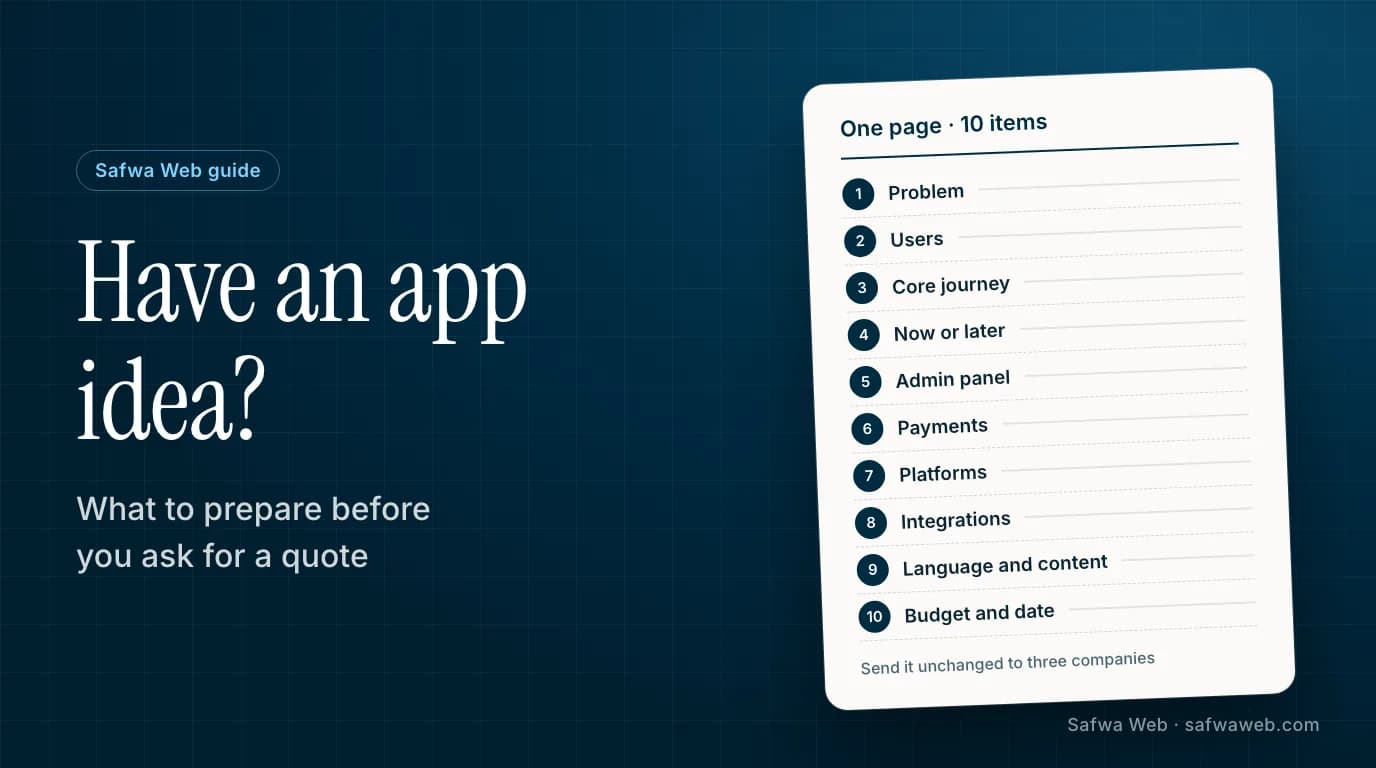
The question we hear most from founders is “I have an app idea — how much will it cost?” The honest answer is that nobody knows yet, including us. The price is not a secret; your idea simply has not become decisions yet, and only decisions can be priced.
This guide turns your idea into those decisions: a one-page brief with ten items, what to write in each, what must be in your name before launch in Saudi Arabia, and how to compare quotes when they arrive.
Why do three companies quote three different prices for the same idea?
When all you write is “I want a delivery app”, each company reads it its own way. One prices a customer app only; another adds a driver app, an admin panel, online payments and notifications.
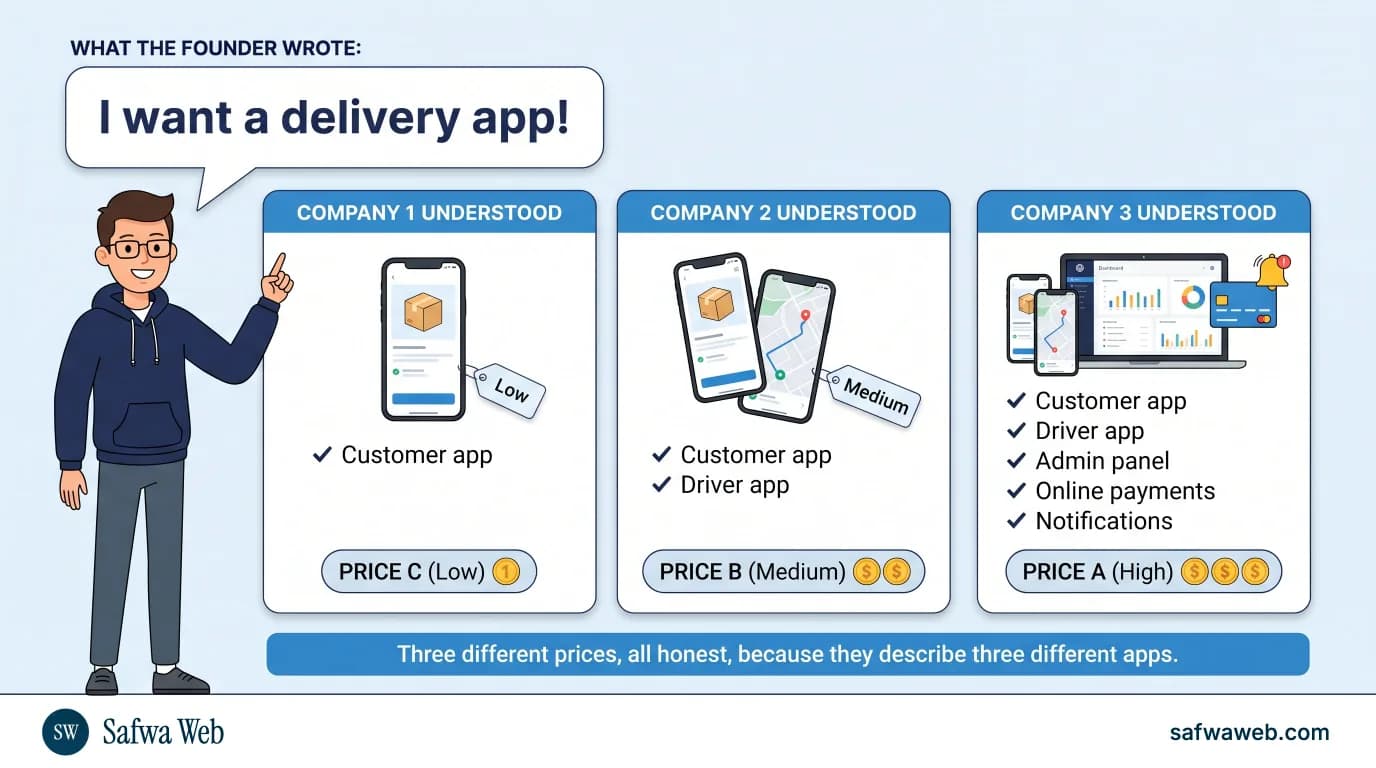
The result is numbers far apart, and all of them honest, because each describes a different app. That is why our guide to what an app costs in Saudi Arabia shows a range from SAR 10,000 to beyond SAR 40,000 under one label: “mobile app”.
The gap between quotes is rarely quality or greed. It is questions nobody answered, and the fix is not haggling; it is one page everyone reads.
Before you write anything: do you need an app at all?
Some ideas are better served by a fast website than an app, at a fraction of the cost. If your customer deals with you fewer than four times a month, read app or website first? before anything else.
If an app is the right tool, test demand before you spend a riyal. Three tests fit into one week:
- Talk to ten people who actually have the problem, not family and friends. Ask how they solve it today and what they pay for that.
- Read the one- and two-star reviews of the three closest competing apps in the store. Those complaints are the first draft of your feature list.
- Offer the service through a simple page or a WhatsApp catalogue, and watch: does anyone ask how to buy?
If nobody asks how to buy, asking for a quote is premature.
The one-page brief: a template for requesting an app quote
You do not need a forty-page requirements document. You need one page with ten items that a developer, a manager and an investor all understand on first read.
Here is the template, filled in for an illustrative car-wash booking app in Riyadh. The example is ours, for explanation only, not a client project:
| Item | What you write | Illustrative example |
|---|---|---|
| 1. Problem | Who has it, and what they do today | Car owners book a wash by phone and wait for a reply |
| 2. Users | Each type, and what it does | A customer books, a washer delivers, a manager oversees |
| 3. Core journey | The steps from opening the app to finishing the task | Picks a service → sets place and time → pays → tracks the washer |
| 4. Now or later | Two separate feature lists | Now: booking, payment, tracking. Later: loyalty points, a monthly plan |
| 5. Admin panel | Who runs the app, and what they see | The manager adds services and prices, sees orders and reports |
| 6. Payments | Do users pay in the app? For what? | Mada and Apple Pay for a service delivered outside the app |
| 7. Platforms | Android, iPhone, web | Android and iPhone from one codebase |
| 8. Integrations | Services and systems it connects to | Maps, SMS verification codes, the accounting system |
| 9. Language and content | Languages, and who supplies text and images | Arabic and English; images and prices from the founder |
| 10. Budget and date | A rough range, and a date with its reason | SAR 25,000–35,000; launch before summer, when demand rises |
Copy the table into a document and fill it in your own words. An incomplete answer beats a blank, because it shows the company what you know and where you need help.
The ten items in detail: what do you write in each?
Each item is one question. Answer it in two or three sentences, and no more.
1. What problem does your app solve?
Write the problem in two sentences: who has it, and what they do today instead of using your app. “An innovative app that makes life easier” is not a problem; “patients wait an hour at the clinic because they don't know their turn” is.
That sentence shapes everything after it. A company that understands the problem may suggest something simpler and cheaper; one that doesn't will build exactly what you asked for.
2. Who will use the app, and how many types of user are there?
Count the types of user, not the number of users. A delivery app has a customer who orders, a driver who delivers and a manager who oversees, and each one sees different screens.
Every new user type means roughly a new interface, and it is one of the biggest reasons prices climb. Write one line per type: what it does, and what it must not see.
3. What is the core journey from opening the app to finishing the task?
List the steps your main user takes, from opening the app to finishing what they came for. Five to seven steps are enough: signs up, chooses, picks a time, pays, tracks.
Sketch it on paper if you can; a rough pen drawing is clearer than a paragraph. From those steps a company can count the screens, which is the basis of any estimate.
4. What must the first version have, and what can wait?
Split features into two lists: what the app cannot work without, and what can wait for version two. A first version (MVP) succeeds when it does one job well, not ten jobs adequately.
Write the reason for every feature on the first list. If the reason is “the competitor has it”, it probably belongs on the second.
5. Do you need an admin panel, and who will use it?
This is the first question we ask every founder, because it is one of the biggest things that moves the price. The admin panel is where you run the app: add products and prices, see orders, suspend an account, read reports.
If you plan to edit content yourself every day, you need one, and it is a full system in its own right. Write who will use it and the first five things they will do in it.
6. Will users pay inside the app, and for what?
This is our second question, and the answer changes three things: the price, the commission and the paperwork you need. The key detail is what the user is buying.
If they buy something digital inside the app, such as a subscription or paid content, Apple requires its in-app purchase system and the stores take a 15% to 30% commission. If they pay for goods or a service delivered outside the app, such as a delivery, a booking or a car wash, payment runs through an ordinary payment gateway, such as Moyasar, that accepts Mada and Apple Pay.
And a payment gateway in Saudi Arabia opens an account for a business, not an idea. Moyasar, for example, requires a commercial registration or a freelance licence, plus a Saudi business bank account linked to it.
7. Android, iPhone or both, and do you need a web version?
Choose platforms by your audience, not by your own phone. Many apps today are built from one codebase that runs on Android and iPhone together, using Flutter or React Native.
On our projects, one codebase for both platforms costs roughly 30% to 40% less than two separate apps. If your customers also need to use the service from a browser, say so explicitly, because that is a third version.
8. What does the app need to connect to?
List every service or system the app must talk to: maps, SMS verification codes, your accounting or inventory system, shipping companies, WhatsApp. Each integration is its own line in the quote, and some carry ongoing costs, like SMS messages charged per message.
If you already run a system, ask its provider one question first: does it offer an API? If it doesn't, the integration can become a project of its own.
9. Which languages, and who supplies the content?
Decide the languages up front: Arabic only, or Arabic and English. A proper Arabic interface is designed right-to-left from the first screen, not flipped at the end.
Write who will supply the text, images, service names and prices. Waiting on content from the client is a common cause of late delivery, so name an owner and a date.
10. What is your rough budget, and when do you need to launch?
State your budget range plainly. A serious company uses it to propose a first version that fits; one that raises its quote because you named a budget reveals itself early.
Write the launch date with its reason: a season, an event, a contract ending. And remember that an app has costs every year after launch, from store account fees to maintenance and mandatory updates, so don't put the whole budget into version one.
What must be in your name before launch in Saudi Arabia?
No company can do these for you, and some take days. Start them now, while you wait for quotes:
- A commercial registration, or a freelance licence where the provider accepts one, and a Saudi bank account in the same name. Payment gateways require both before activating your account. A freelance licence is enough for the payment gateway, but Apple's organisation account needs a registered legal entity.
- A D-U-N-S number for your business, which is free. Google Play will not create an organisation developer account without one, Apple requires it too, and Apple says issuing can take up to five business days, plus up to two more before it reaches them.
- An Apple developer account in your organisation's name for USD 99 a year, and your organisation's name is what the App Store shows as the seller. Plus a Google Play account for a one-time USD 25 fee.
- A working website on your own domain, with an email address on that domain. Apple does not accept a social media link in place of a website when enrolling an organisation.
If you enrol with a personal account instead, your personal name appears as the seller on the App Store, and new personal Google Play accounts must pass a mandatory closed test before publishing.
Most important: never let any of these accounts be opened in the agency's name. We have seen what happens when an agency disappears with your accounts, and fixing it afterwards is far harder than preventing it now.
What don't you need to prepare?
The founder decides what and why; the company decides how. So don't wear yourself out on these:
- Choosing the programming language, database or server. Only mention an existing system you must stay compatible with.
- A long technical requirements document (SRS). One page is enough for a first quote; the details get written later with the company you choose.
- Final screen designs. Screenshots of apps you like, with why you like each, are more useful than a half-finished design.
- Certainty on every item. Write “I don't know” where you don't, because that gives the company real information.
Will a development company steal my app idea?
The fear is understandable, but the reality is simpler than you think. Copyright protects the executed work, such as code, design and text, not the bare idea, a principle set out in the TRIPS Agreement that Saudi Arabia is bound by.
What separates two similar ideas in the market is execution, not who thought of it first. So protect what is actually worth protecting:
- Explain the general idea on the first call, and keep the sensitive details, such as your customer data or your pricing model, for later.
- Ask for a non-disclosure agreement (NDA) before handing over detailed documents or data. Many companies decline to sign one on the very first call because they hear similar ideas all the time, and that alone is not a red flag.
- Make sure the contract states plainly that the source code and design are yours once paid. Refusing that is the real red flag.
- Open every account in your own name, as described in the previous section.
How do you send the brief and compare app development quotes?
Send the same page, unchanged, to three companies. Ask each for an itemised quote rather than a single number, and ask: what did you assume that I didn't mention?
Be wary of a number that arrives within an hour without a single question. A company that asked you nothing has priced a different app from the one in your head.
Compare quotes on these lines, because anything missing from a quote can come back later as an extra invoice:
| What every quote should state | Why it matters to you |
|---|---|
| Written scope: screens and features | What isn't written won't be built, or will cost extra |
| What is out of scope | It exposes assumptions before they turn into disputes |
| Number of apps, and the admin panel | A customer app alone is not a customer app, a driver app and a panel |
| Testing and publishing on both stores | Some quotes stop at handing over code |
| Post-launch support and its length | Mandatory store updates will come |
| Ownership of code and accounts | It must be written in your favour, explicitly |
| Payment schedule tied to deliverables | You pay for work you can see, not for promises |
When quotes come out close, choose on answers, not on price. We prepared the ten questions to ask before hiring any company for exactly that, and most of them apply to apps as much as to websites.
What happens when you send us this page?
We read it, then ask about whatever is missing, always starting with the admin panel and payments. Then we send a written scope with a fixed price and a launch date, and the price does not change mid-project.
During the build you get a working version on your own phone every week. Details of the service and the platforms we build for are on our mobile app development page.
The bottom line: what to do this week
- Test demand: ten conversations with people who have the problem, and the competitors' reviews.
- Fill in the one-page brief; “I don't know” is an acceptable answer.
- Answer the two questions that move the price most: admin panel and payments.
- Start your paperwork: registration or licence, bank account, D-U-N-S number.
- Send the same page to three companies and compare quotes line by line.
Your idea doesn't need to be complete to ask for a quote. It needs to be clear, and the one-page brief is the difference between a number a company guesses and a number you can rely on.
Frequently asked questions
How much will my app idea cost to build in Saudi Arabia?
There is no honest number before the one-page brief is answered, especially the admin panel and payments. As a general range, our first versions start at SAR 10,000, and full apps with a backend, admin panel and Saudi payments typically run SAR 10,000 to 40,000 or more; the details are in the cost guide on our site.
Do I need a technical requirements document (SRS) before contacting a development company?
No. A one-page brief with ten items is enough for an accurate first quote: problem, users, core journey, features, admin panel, payments, platforms, integrations, language, and budget and date. The detailed document gets written later with the company you choose.
Should I ask for an NDA before explaining my app idea?
Explain the general idea on the first call, and ask for an NDA before handing over detailed documents or data. A company declining to sign on the first call is common; refusing to state in the contract that you own the code and design is the sign to walk away.
How long does it take to build the first version of an app?
Our first versions (MVPs) typically take 10 to 14 weeks from kickoff to store approval, and larger apps 4 to 6 months. Add time to set up the accounts in your name: the D-U-N-S number alone can take one to several weeks.
Do I need a commercial registration to launch an app in Saudi Arabia?
If the app takes payments, gateways require a commercial registration or a freelance licence with a Saudi bank account, and an organisation developer account needs a legal entity and a D-U-N-S number. You can publish with a personal developer account, but your personal name appears as the seller on the App Store, and new personal Google Play accounts must pass a mandatory closed test before publishing.
My budget is limited. Where do I start?
Test demand first at almost no cost, then build a first version that does one job only. In many cases a fast website or a progressive web app (PWA) is a cheaper start that proves the idea before a store app.