Hiring ·
10 Questions to Ask Before Hiring a Web Design Company in Saudi Arabia
These ten questions are ordered by how much money they save you, not by how important they sound. If you only ask one, ask the first — it is the question that decides whether the website is still yours a year from now. Under each one you will find the good answer as it is actually spoken, and the evasive answer as it is actually spoken, so you can tell the difference while you are still sitting in the meeting instead of after you have signed and paid.

Before you ask anything: what are you actually buying?
Most people who commission a website think they are buying a design. What you are really buying is a business asset made of five keys: the domain, the hosting, the site files and database, the content, and your presence on Google. The design is the only item on that list you can easily change later. Lose any of the others and they are gone.
That distinction explains something we have seen in every rescue job we have taken on. Serious disputes between business owners and web companies are almost never about taste or colours. They are about who holds the keys. The owner wants a small edit and discovers he cannot log in to his own website. Or he wants to move to another company and discovers the domain is registered to somebody who has stopped answering the phone.
The ten questions below are built to surface all of that before you pay rather than after. Ask them exactly as written. A serious company will be comfortable with them because it already knows the answers — and a company that bristles at them has answered you without meaning to.
The ten questions
1. Who owns the domain, the hosting and the site files after handover?
Why it matters: This is the question that separates owning your website from renting it without realising. And if you are planning a .sa domain, pay attention: registration through SaudiNIC is tied to a commercial registration, so if it goes in the agency’s name, recovering it later becomes a long administrative fight instead of a simple transfer.
✅ A good answer sounds like: "The domain is registered to your business under your commercial registration. Hosting sits on an account in your name and we manage the technical side only. At handover you receive every login, the site files and the database. If our relationship ended tomorrow, nothing of yours stops working."
❌ An evasive answer sounds like: "Don’t worry about it, we keep everything safe" — or "We register the domain under our name because it’s administratively easier, and we’ll transfer it whenever you like." The second is more dangerous because it sounds reasonable. Ask for it in your name from day one, not later.
We wrote the full recovery process for people already in that position — including how to get your Google Business Profile back — in our guide to taking your website back from an agency that disappeared.
2. Is the price final and in writing? What is not included?
Why it matters: Most money disputes are not about the number you agreed. They are about what was never mentioned. Content, photography, translation, annual hosting, payment gateway integration, the security certificate — if each of these is not written explicitly as either inside or outside the price, it arrives as an extra invoice halfway through, at exactly the point where walking away is expensive for you.
✅ A good answer sounds like: a written proposal listing page count, languages, the technology used, how many revision rounds are included, and — crucially — an explicit list of what is out of scope. A confident company writes its exclusions plainly because it does not rely on them to make its margin.
❌ An evasive answer sounds like: "The price depends on your requirements," said after you have explained your requirements in detail. Or "Let’s start and agree the rest as we go." Or a verbal figure in a WhatsApp thread with no written proposal behind it.
Before you compare any two quotes, understand what actually moves the number — we break it down with real figures in riyals in our guide to what a website costs in Saudi Arabia. A quote with no detail is not a cheap quote, it is an incomplete one.
3. Who will actually work on my site — your team or a freelancer?
Why it matters: Plenty of proposals are delivered by people who will never touch your project after signature. You sit with someone polished and convincing, then the work is handed to a day-rate freelancer who knows nothing about your business and nothing about what you agreed verbally.
✅ A good answer sounds like: "A designer and a developer from our team will work on this — here are their names and roles, and your single point of contact is the project manager. If we bring in an outside specialist for a specific piece, we’ll tell you before we do."
❌ An evasive answer sounds like: "We have a full team" — with no name, no role, and no clarity on who picks up the phone when you call.
4. Show me three sites you built at least a year ago — are they still running?
Why it matters: A portfolio shows what a company managed to design, not what it managed to deliver and keep alive. The gap between those two things is the gap between a company that executes and a company that disappears. One site that is a year old and still running and still being updated is stronger proof than twenty images in a deck.
✅ A good answer sounds like: live links you open yourself, right there, plus a sentence like: "Call them and ask about us, we don’t mind." A company that invites you to contact its past clients already knows what they will say.
❌ An evasive answer sounds like: design mockups with no links, or "our projects are confidential," or links that no longer load — and that last one is the worst, because it means either the clients left or nobody renewed the hosting.
We publish our projects with their real live links for exactly this reason.
5. Template or custom build? And on which platform?
Why it matters: There is no permanently correct answer here. A template is an excellent decision for a brochure site on a limited budget, and a custom build is necessary when the website is part of how you operate. The mistake is not choosing one over the other — it is paying custom prices and receiving a template, or being built on a platform you cannot name and cannot manage.
✅ A good answer sounds like: they explain the difference honestly, recommend based on your situation rather than on what they want to sell, and name the platform and stack — WordPress for a site you will update yourself with changing content, or a custom Next.js build when you need speed, performance and integration with your systems.
❌ An evasive answer sounds like: "100% custom design" with no technology mentioned at all, or sidestepping the question to talk about visuals. Ask for the platform to be named in writing inside the proposal.
We are seeing exactly this right now with Roof, a Saudi real estate establishment. Their previous site was not connected to their CRM, so the Google Ads they were running brought in enquiries that never reached the sales team — ad budget spent on customers who were lost in the gap between the website and the system. We connected the CRM to the existing site first as immediate first aid, and we are now building the replacement outright. None of that was a cosmetic problem. The site had simply never been built to be part of how they operate.
6. What is the timeline, and what happens if you are late?
Why it matters: Every company gives you a duration. Very few give you a consequence for missing it. The difference between a promise and a commitment is whether anything happens when it is broken.
✅ A good answer sounds like: phases with dates — discovery, design, build, review, launch — and an honest account of what could delay things. The most truthful answer here is usually "your delay in supplying content and photos is the number one cause of slipped timelines" — paired with a written clause covering what happens when the delay is theirs.
❌ An evasive answer sounds like: "Two weeks, inshallah," with no phases. Or an implausibly short timeline offered to win you, followed by drift as soon as the first payment clears.
7. Will my site appear on Google? What exactly will you do?
Why it matters: A website nobody can find is a digital brochure. This question in particular flushes out the most common lie in the market.
✅ A good answer sounds like: concrete things — a title and description structure for every page, load speed, a genuine Arabic version, structured data, analytics connected, and a Google Business Profile set up properly. Followed by the honest sentence: "Visibility takes time and ongoing content. The website is the start, not the finish."
❌ An evasive answer sounds like: "Page one of Google in 30 days — guaranteed." Nobody owns a ranking guarantee, and Google does not sell one either. Anyone promising this either does not understand it, or understands it perfectly and knows you will not find out until after you have paid.
8. Who answers me after launch, and what does support cost per year?
Why it matters: A website is not a one-off purchase. There is domain and hosting renewal every year, security updates, and content changes. A company that will not price this upfront will either surprise you with an invoice or vanish after launch, because support was never profitable for them in the first place.
✅ A good answer sounds like: a clear annual figure, a list of what it does and does not cover, a written warranty period on bugs after handover, and a defined support channel rather than a personal number that may change.
❌ An evasive answer sounds like: "Free lifetime support." Nothing is free for a lifetime. In practice that sentence means there is no written obligation and you will be helped when they happen to be free.
Know what you will pay every year after launch before you sign, not twelve months later.
9. Is the site Arabic-native, or a translation?
Why it matters: You will not find this question in any foreign article about choosing a web design company, and it is one of the highest-impact questions in the Saudi market. A real Arabic site is not English text flipped to the other side. Page direction, typefaces, how numbers sit, where buttons belong and how headings are written all differ.
✅ A good answer sounds like: "The Arabic version is built independently with full RTL, in an Arabic typeface suited to long-form reading, with search titles and descriptions written in Arabic rather than translated, on its own URL so Google indexes it separately."
❌ An evasive answer sounds like: "We’ll add an auto-translate plugin." Machine translation gives you a site your Saudi customer reads and immediately senses was not written for him — and leaves.
10. Do you have a commercial registration and issue a tax invoice? And where is the contract?
Why it matters: This is the question that determines whether you have anyone to hold accountable at all. A transfer to a personal account against a promise on WhatsApp is not a contract, and it leaves you no formal recourse.
✅ A good answer sounds like: a commercial registration number you can verify, a proper tax invoice, and a written contract covering scope, duration, payments and ownership after handover. And if you run an online store, a good company raises requirements like Maroof verification and e-invoicing before you have to ask.
❌ An evasive answer sounds like: "We can do it cheaper without an invoice." The discount is priced in what you gave up: your ability to make a claim.
Does the company have to be in your city?
A question that comes up constantly, and the honest answer is no, it is not a requirement — but a local presence does mean one thing that matters, which is that the company understands your market and can meet you when the situation calls for it. More important than an address is that the company has a legal entity in Saudi Arabia you can turn to, and that it understands how your local customer searches.
If your business is in the capital, the search that matters to you is "web design Riyadh" and everything around it, which needs a page and a business profile tuned to that city — which is what we cover on our web design in Riyadh page. Be wary of any company claiming branches in every city without one verifiable address.
Five signs you should walk away now
- A ranking guarantee. "Page one within a month, guaranteed" — there is no such thing as a guaranteed ranking.
- Refusing to define what is outside the price. If they will not write their exclusions down, they are counting on them.
- Full payment upfront. Milestone payments protect both sides. Paying everything in advance protects one.
- Badmouthing the previous agency. Anyone who opens a relationship by running down someone else will describe you the same way to the next client.
- No written scope. No contract, no document, nothing but WhatsApp messages. If a dispute happens there is nothing to point at.
The questions a good company asks you
A good meeting is not a one-way interrogation. Watch whether they ask you anything at all, because a company that does not ask will not build you anything different from what it builds for everyone else.
- What is the website for — calls, orders, hiring, or credibility before the meeting?
- Who is your customer, and what is the question in their head before they contact you?
- What separates you from your closest competitor, in one sentence?
- What happens after a visitor submits the form — who replies, and how fast?
- How will we know in six months whether this worked?
If you leave the meeting having had your business understood better than you understood their design, you are with the right company.
What happens when nobody asks question one
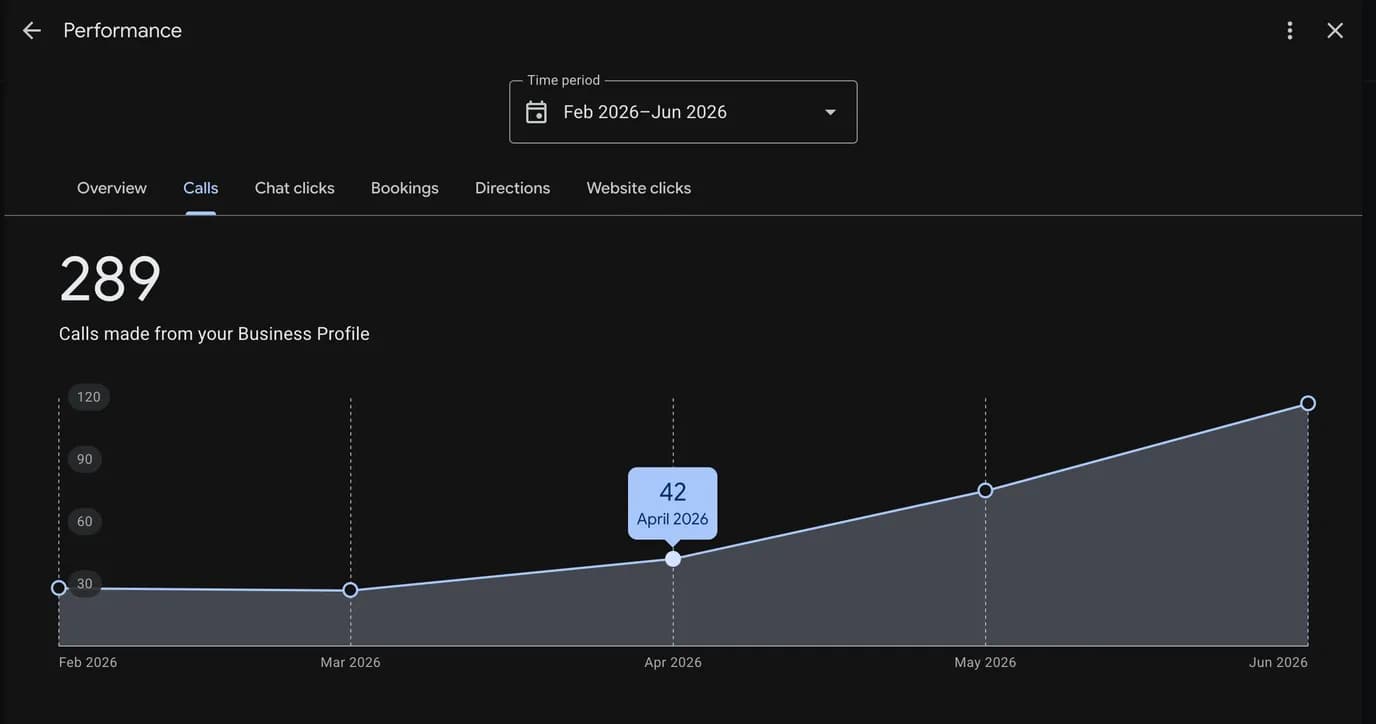
A construction client of ours had previously worked with a party that ran ads for them and then stopped replying and disappeared — leaving them without access to their own digital presence. When we started, the first step was recovering ownership and fixing the Google Business Profile, not design.
The result, as it appears in the profile dashboard: 289 calls between February and June 2026, rising from around 30 a month to more than 70, alongside 7,340 views. Their business did not change and neither did their services. What changed is that the keys came back into their hands.
Compare them yourself
Take this table into the meeting and fill it in while they talk, not afterwards. The company that leaves you with blank cells has already answered your question.
| Question | Company A | Company B | Company C |
|---|---|---|---|
| Domain and hosting in my name? | |||
| Final written price with exclusions? | |||
| Names of who will do the work? | |||
| 3 live sites at least a year old? | |||
| Template or custom? Which platform? | |||
| Phases with dates and a late clause? | |||
| Realistic visibility plan, no guarantees? | |||
| Annual support cost in writing? | |||
| Arabic-native, not translated? | |||
| Commercial registration, invoice, contract? |
The bottom line: asking these questions does not make you difficult, it makes you a conscious buyer. We answer all ten on the first call, and our numbers have been published on this site from day one — because a company hiding its figure is usually hiding a few other things alongside it.
Frequently asked questions
How long does it take to build a website?
A brochure site with clear requirements usually takes two to four weeks. An online store or a site connected to other systems takes longer. The biggest cause of delay is not development — it is content and photos arriving late from the client.
Should I hire a local Saudi company or can I use a foreign one?
What matters most is that the company has a legal entity you can turn to, issues a tax invoice, and works to a written contract. A local company has the edge on understanding the market, Arabic search and meeting face to face — but an address alone is not a guarantee.
What is the difference between a template and a custom build?
A template is faster and cheaper and suits a brochure site with ordinary requirements. A custom build is made around your needs and suits sites tied to operations, systems or high performance. The mistake is paying custom prices and receiving a template.
Can I move my website to another company later?
Yes, if you own the domain, the hosting and the site files. If any of those sit in the agency’s name, moving becomes a negotiation rather than a procedure. That is why it is question one in this article.
What should the contract include before I pay?
Scope by page count and languages, the platform and stack, number of revision rounds, timeline and payment milestones, what is explicitly out of scope, ownership of domain, hosting and files after handover, and the warranty period on bugs.
How do I know a company is trustworthy before paying?
Check three concrete things: a commercial registration you can verify, live sites they built a year ago that still work, and a written proposal that states what falls outside the price. Certificates and mockups alone are not evidence.
Is a website alone enough to appear on Google?
No. The website is the foundation, but local visibility also needs a properly configured Google Business Profile, ongoing content and time. Anyone promising a guaranteed ranking within weeks is selling you an illusion.