WordPress vs Custom Website: How to Choose for Your Business in Saudi Arabia
Strategy ·
WordPress vs custom website: the answer follows what your website does, not the size of your company. Choose WordPress if the site presents your business, Salla or Zid if it sells standard products, and custom code if it runs part of your operations, such as bookings, customer accounts and links to your systems. This guide gives you a decision table, sourced numbers on security, speed and cost, and what other comparisons leave out about payment and e-invoicing plugins in the Saudi market.
This question usually comes up when you ask for website quotes and get two that look nothing alike. The first promises a WordPress site in a few weeks. The second proposes a custom build at a higher price and says WordPress is slow and insecure.
Both can be right. It depends on what you need the website to do.
At Safwa Web we build both ways, so we have no reason to push one over the other. Every number in this guide comes from its source, and we checked each one on 13 November 2026.
The quick answer: what does your website do?
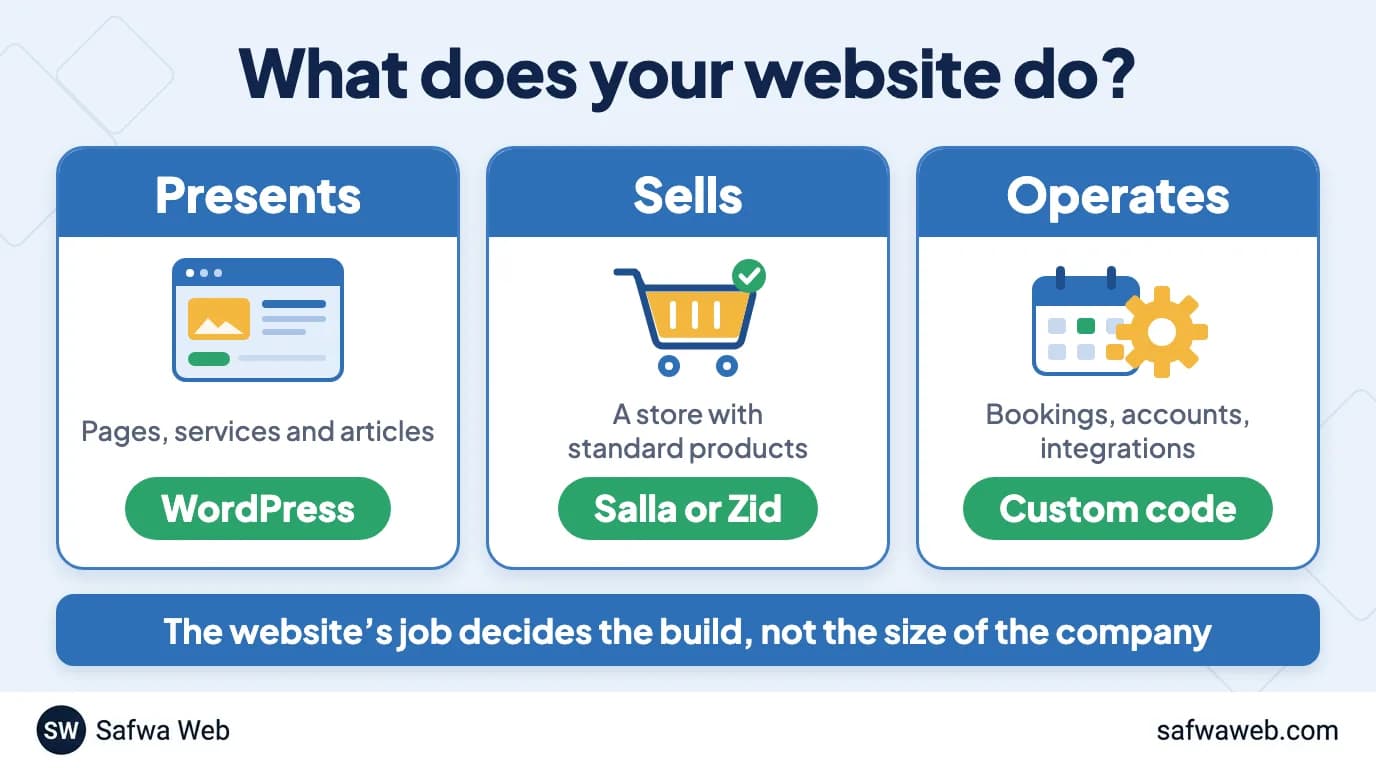
Before you compare technologies, decide what job the website has. Most business websites do one of three jobs:
- It presents: it introduces your company, services and past work, publishes articles and takes enquiries. WordPress is enough here in most cases.
- It sells: a store with standard products and prices. Start with a store platform such as Salla or Zid, before WordPress and before custom code.
- It operates: it books appointments, opens customer accounts, calculates prices or connects to your internal systems. Custom code is the right route here.
This table applies the rule to the cases that come up again and again in the Saudi market:
| Your case | Best fit | Why |
|---|---|---|
| A company site with services, about and contact pages, where your team publishes articles and news regularly | WordPress with a custom theme | A ready-made editor that non-technical staff learn quickly |
| A small brochure site whose content changes once or twice a year | WordPress or a custom-coded site; compare both quotes | You won’t need an editor every day, so price and speed decide |
| A store with standard products, payment and shipping | Salla or Zid | Payment and shipping are built into the platform |
| A store that needs pricing or a buying experience the platforms don’t offer | WooCommerce or a custom-coded store | Full control, along with responsibility for maintenance |
| A site that books appointments against schedules, or calculates complex prices | Custom code | The booking and pricing logic is the heart of the site, and a ready-made plugin rarely covers it well |
| A customer or supplier portal, or a subscription platform | Custom code | This is a system, not a website |
| A site that must send every enquiry to a CRM or accounting system | Either can work | What matters is that the connection is written for your system and tested before launch |
What is the difference between WordPress and a custom website?
WordPress is a free, ready-made content management system. You install it on your hosting, choose a theme that sets the look, and add features through plugins. It runs 39.2% of all websites, according to W3Techs on 13 November 2026.
A custom website, also called a custom-coded or bespoke website, is written from the start with a framework such as Next.js or Laravel. There is no theme and no plugins: every page and feature is built for your project. Even the admin panel you edit content from has to be built, if you need one.
Between the two sit options many people overlook. In practice there are four choices, not two:
| Option | What it is | When it fits |
|---|---|---|
| WordPress with a ready-made theme | A purchased theme with its look and content changed | Lowest cost and fastest launch, but it can look like other sites that bought the same theme |
| WordPress with a custom theme | A design written for you on top of WordPress, with few plugins | A company site your team edits that still stays fast |
| Custom code | A site written entirely with a framework | A site that runs part of your business, or a design that templates can’t deliver |
| A store platform such as Salla or Zid | A ready-made store on a Saudi platform | Selling standard products without building anything |
So ask every company that offers you “WordPress”: with a ready-made theme or a custom theme? The name is the same, but the result is very different.
How do you tell if a website is built with WordPress?
Open the site on a computer, right-click and choose “View page source”, then search for wp-content. If you find it, the site runs on WordPress. Try this on any agency’s past work before you sign, so you know what they actually build with.
WordPress vs custom website: 8 points compared
| Point | WordPress | Custom code |
|---|---|---|
| Time to launch | Shorter, because it starts from a ready-made system | Longer, because every page and feature is written and tested |
| Editing content | A ready-made editor non-technical staff can use | No editor unless one is built, and that is a line in the price |
| Special features: booking, pricing, accounts | Ready-made plugins for common needs; it gets complicated with unusual ones | Built around the way your business works |
| Speed | Good when the theme is light and plugins are few | High when the developer builds it well |
| Security | The core system is secure; the risk is in plugins that aren’t updated | No plugins, but it depends on code quality and updated libraries |
| SEO | Ready-made tools for titles, the sitemap and structured data | Everything is possible, as long as it gets built and not forgotten |
| Yearly cost | Hosting, plugin licences and updates | Hosting, and developer time for any change |
| Changing agency later | Easy, because WordPress developers are everywhere | Depends on the code being documented and handed over to you |
The table is the summary. The next sections explain the parts that need it: security, speed, the Saudi market and cost.
Is WordPress secure?
WordPress itself is secure. The risk is in plugins. Patchstack, a WordPress security company, counted 11,334 new vulnerabilities during 2025 in its State of WordPress Security in 2026 report: 91% in plugins, 9% in themes, and only six in WordPress core, all of them low priority.
What happens after a vulnerability is found matters more. According to the same report, 46% of vulnerabilities had no fix by the time they were made public. About half of the high-impact ones were exploited within 24 hours, and the most heavily targeted within hours, not days (a median of five hours).
Many sites fall behind on updates: 30.8% of WordPress sites still run version 6 or older, although the current version is 7, according to W3Techs.
The practical rule: as few plugins as possible, from developers who update them regularly, and one named person responsible for updates every month. A WordPress site that meets those conditions is safe for your business.
Custom code doesn’t free you from updates either. Our own website is custom-coded in Next.js, and in October 2026 we updated three libraries it depends on to close published vulnerabilities. The difference is that a custom site doesn’t carry dozens of plugins from different developers, but its security depends on a developer who watches its libraries and keeps them updated.
Which is faster, and which is better for SEO?
Google doesn’t favour one platform over another. John Mueller of Google said it plainly in December 2020: “We don’t prioritize crawling, indexing, or ranking by platform used.” What counts is what the visitor gets: a fast page, clear headings and useful content.
On speed, though, there is a real gap. HTTP Archive’s Web Almanac 2025 measured real websites on mobile and found that only 45% of WordPress sites pass Core Web Vitals, Google’s measures of how fast a page loads, how quickly it responds and how stable its layout is. That is among the lowest rates of the systems the report measured.
That number doesn’t mean WordPress is slow by nature. The same report says the wide variation between WordPress sites comes from build and setup choices more than from WordPress itself. A WordPress site with a light theme and few plugins passes easily, and a carelessly coded custom site can be slower than it.
So don’t ask “which technology is faster?”. Ask the company to put the mobile speed result in writing in the proposal, and open their past work on your own phone before you sign.
What comparisons leave out: plugins for the Saudi market
The strongest argument for WordPress is that “there is a ready plugin for everything, tested on millions of sites”, which is true for global features and less true for what the Saudi market needs. We checked the official WordPress plugin directory on 13 November 2026. These are the numbers as they stand, and all seven plugins had been updated in the two months before:
| Plugin | What it does | Active sites |
|---|---|---|
| WooCommerce | A store on WordPress | More than 7 million |
| Elementor | Page building | More than 10 million |
| Tabby Checkout | Instalment payments through Tabby | More than 4,000 |
| Tamara Checkout | Instalment payments through Tamara | More than 3,000 |
| Moyasar | Payment gateway: mada, Apple Pay and STC Pay | More than 1,000 |
| HyperPay Payments | Payment gateway: mada, STC Pay and cards | More than 600 |
| ZATCA E-Invoice for WooCommerce | Simplified tax invoice with a QR code | Fewer than 20 |
A fair reading of these numbers: the payment providers used in Saudi Arabia publish official plugins and keep them updated, which is good. But their users number in the thousands, not millions, so problems take longer to surface. To be fair, the official directory only counts plugins published in it, and some providers hand out their plugin from their own site, so those don’t show up in these numbers.
With custom code there is no plugin in the middle: the developer connects your site directly to the gateway’s API. That takes longer to build and gives you full control over the payment experience.
Is there a WordPress plugin for ZATCA e-invoicing?
There are some, but very few sites use them. A search for “zatca” in the directory returned 11 plugins, and none of the ones made for Saudi invoices is active on more than a few dozen sites.
As a reminder, e-invoicing has applied to taxpayers in the Kingdom since 4 December 2021, and the phase that integrates with ZATCA’s systems has been rolling out in waves since 1 January 2023. This is general information, not tax advice.
Three things to ask for before launch
- Ask for the payment gateway and the way it will be connected to be written in the proposal: an official plugin from the gateway itself, or code the developer writes.
- Test a payment yourself before launch, with a mada card and with Apple Pay, on a real phone, whether your site is WordPress or custom.
- Don’t rely for e-invoicing on a plugin that fewer than 20 sites use. Issue invoices from your accounting system, and ask how the store will connect to it.
Arabic and English together
WordPress supports Arabic and right-to-left text, and has an official Arabic version. But a two-language site needs a translation plugin: Polylang has a free version that is active on more than 900,000 sites, while WPML is paid.
The theme matters more than the plugin. Some ready-made themes are designed for English first and then “flipped” for Arabic. Ask to see the same theme in Arabic on a phone before you buy it.
With custom code there is no theme to flip, so you can ask for the Arabic version to be designed first and the English one after it. Put that request in the proposal.
Which is cheaper, and what really moves the price?
WordPress is free, but a WordPress website is not. The system is open source and costs nothing. You pay for what surrounds it: hosting, the domain, the theme, paid plugins, and the people who build and maintain it.
Paid plugins renew every year. Two examples from the official pricing pages in November 2026: Elementor’s paid plans start from $60 a year, and WPML’s full plan for multilingual sites costs €99 and includes one year of updates. Always ask: how many paid plugins will my site have, whose name are the licences in, and what does renewal cost?
Custom code is not always the more expensive option, despite what people say. What raises the price on either route is what the website does, not the name of the technology. In our experience, two questions move the price more than any others: do you need an admin panel, and do you need online payment?
With WordPress the admin panel comes ready, and that is its biggest financial advantage. With custom code the panel has to be built and goes into the price. If your content changes every week, count it in from the start.
First-year cost: WordPress vs custom code
| Item | WordPress | Custom code |
|---|---|---|
| Build | Usually lower, because the base is ready | Usually higher, and it rises with an admin panel |
| Yearly licences | A paid theme and plugins that renew | Usually none |
| Hosting | Standard hosting is enough for most sites | Varies with the technology, so ask before you sign |
| Small changes | Your team makes them | Need a developer if no admin panel was built |
| Updates | At least monthly, for the system and plugins | Periodic, for the code libraries |
Ask each company for two separate numbers: the cost to build, and the cost to run the site for the first year including hosting, licences and maintenance. Current market prices are in our guide to website cost in Saudi Arabia.
What if your website is an online store?
A store has three routes, not two. A platform such as Salla or Zid comes with payment and shipping built in, and it is the right start for most stores. WooCommerce on WordPress gives you more control over design and data, along with responsibility for the plugins and updates you saw in the table.
A custom-coded store earns its cost when the way you sell includes something the platforms don’t offer: pricing by quantity or size, subscriptions, or a direct link to your stock. The full platform comparison is in our post on Salla vs Zid vs Shopify, and what Salla’s plans really cost next to your own store is in Salla plans 2026.
Can you start with WordPress and move to custom code later?
Yes. Content moves easily, and the hard part is keeping your Google rankings.
Every old URL must be permanently redirected (301) to its matching new URL, and the titles, descriptions and images must move with it. The full steps are in our guide to a website redesign without losing rankings.
There is also a third answer that suits many companies: both together. The company site and articles run on WordPress so the marketing team can edit them, and the part that runs the business (a customer portal or a booking system) is custom-coded and linked to the site.
8 questions to ask before you sign any proposal
Whether you are offered WordPress or custom code, these questions reveal the quality of the proposal better than the name of the technology:
- What is the platform or framework called? Ask for it in writing in the proposal.
- If it is WordPress: a ready-made theme or a custom theme? How many plugins will be installed, and which ones?
- How many paid plugins are there, what does renewal cost each year, and whose name are the licences in?
- What can I change myself after handover? Show me on a site you have built.
- Which payment gateway will be used, how will it be connected, and who tests mada and Apple Pay before launch?
- Was the Arabic version designed from the start, or flipped from the English one?
- Who updates the site after handover, and what does that cost per year?
- Are the domain, hosting, code and admin account in my name? Read how to check who owns your domain before you pay.
For the full list before you sign, read 10 questions to ask before hiring a web design company.
How do we choose between the two?
We build WordPress sites with custom themes, and we code with Next.js and Laravel. We choose between them with three questions: what the website does, who will edit its content, and what it needs to connect to. After that the choice is clear, and we write the name of the technology in the proposal.
If your website presents, see our WordPress development service. If it runs part of your business, see our Next.js development service. And if you aren’t sure, send us what you want the website to do and we will tell you which fits, and why.
Frequently asked questions
WordPress vs custom website: which is better?
Neither is better for everyone. WordPress suits a site that presents your company and publishes content your team updates. Custom code suits a site that runs part of your business, such as bookings, customer accounts and links to your systems. A store with standard products should start with Salla or Zid.
Is WordPress free?
Yes. WordPress is free, open-source software released under the GPL licence. You still pay for hosting and the domain, for a theme and paid plugins that renew every year, and for the people who build and maintain the site.
Is WordPress secure?
WordPress itself is secure; the risk is in plugins that are not updated. According to Patchstack’s 2026 report, 91% of the WordPress vulnerabilities found in 2025 were in plugins and only six were in WordPress core. A site with few, updated plugins and a named person responsible for updates is safe for your business.
What are the disadvantages of WordPress?
Three main ones. First, it depends on plugins that need constant updates and licences that renew every year. Second, sites loaded with plugins are slow: only 45% of WordPress sites pass Core Web Vitals on mobile, according to the Web Almanac 2025. Third, special features such as booking and complex pricing are hard to build.
What are the disadvantages of a custom website?
Three as well. First, it takes longer to build, because every page and feature is written and tested. Second, the admin panel doesn’t come ready: if one isn’t built, you need a developer for every change. Third, you depend on whoever wrote the code, so if it isn’t documented and handed over to you, another company will struggle to continue the work.
Is a custom website better for SEO than WordPress?
No. Google doesn’t favour one platform over another for crawling, indexing or ranking. What counts is page speed, clear headings and content quality. All three can be done well on either route, and neglected on either route.
Can I move from WordPress to a custom website later?
Yes. Content moves easily. What matters is that every old URL is permanently redirected (301) to its new URL so you don’t lose your Google rankings. Plan the redirects before the move, not after it.
What is best for an online store in Saudi Arabia?
Start with Salla or Zid if your products and the way you sell are standard, because payment and shipping are built into the platform. Choose WooCommerce or a custom-coded store when you need pricing or a buying experience the platforms don’t offer, and count the cost of maintenance with it.